Is bigger always better?
Everyone's chasing bigger models.
More parameters. More compute.
Billions of dollars are flowing into the same bet.
Scale will solve everything.
It's the default assumption of the entire AI industry.
Raise more money.
Buy more GPUs.
Train on more data.
If the model isn't working, make it bigger.
This isn't strategy. It's an arms race with no finish line.
And it's creating a generation of AI companies that look impressive on paper but can't deliver reliable results in production.
It won't work.
Building a bigger AI model without solid governance is like adding floors to a skyscraper built on sand. It doesn't matter how impressive it looks. The foundation is the problem.
There's another way. One that prioritizes coordination over raw power. Architecture over scale. Ownership over rent.
That's what this piece is about.
Want to learn how Gorombo plans to spend a $500,000 investment? Check out this YouTube video 👉 The AI industry is WRONG. Here's why.
You Don't Need a Bigger Brain
Cognitive Governance over Scale. You don't need a bigger brain; you just need to know how to use it.
Here's the thing nobody wants to admit. The model isn't where intelligence lives.
Think about it.
Human intelligence doesn't come from brain size. Elephants and whales have bigger brains than we do.
What makes us different is the system that coordinates everything. The governance layer. The processes that turn raw neural activity into coherent thought and action.
AI works the same way.
You can have the most powerful model on the planet. Trillions of parameters. Trained on every piece of text ever written.
And it will still hallucinate.
It will still contradict itself.
It will still confidently give you wrong answers with a straight face.
Why?
Because raw capability without coordination is chaos.
This is the core philosophy behind the SIM-ONE Framework.
Intelligence resides in the governance layer, not the LLM itself. It's a shift from brute force to what we call governed cognition.
The model is the engine. Governance is the driver.
Nobody buys a car because it has the most horsepower. They buy it because it gets them where they need to go safely and reliably.
The same logic applies here.
What good is a powerful model if you can't trust its output? What good is scale if it just means bigger mistakes, faster?
Capability without governance isn't intelligence.
It's volatility.
And volatility is expensive.
In dollars. In reputation. In the trust you're trying to build with customers who are betting their operations on your product.
Your Support Queue Is a Gold Mine

Your support queue is our gold mine. Every ticket you submit just makes our company more valuable.
Most companies treat customer support as a cost center. Something to minimize. Automate away. Outsource to the cheapest bidder.
That's backwards too.
Every support interaction is training data.
Not just for answering questions, but for teaching AI agents how to work together. When a human corrects a response in a properly architected system, they're not just fixing one answer. They're teaching an entire team of specialized agents how they should have coordinated to get it right the first time.
The system learns teamwork, not just facts.
This is fundamentally different from how most companies approach AI.
They fine-tune a single model on Q&A pairs and call it a day. That's surface-level learning. It's memorization, not intelligence.
A properly governed multi-agent system learns something deeper.
It learns process. It learns coordination. It learns how to break a problem into pieces and assign those pieces to the right specialists.
And here's the kicker.
Your competitors can't steal this.
They can scrape your website. They can poach your employees. They can even get access to the same foundation models you use.
But they can't replicate the thousands of micro-corrections your team has fed into a system designed to learn from them.
This creates what we call the HRLF Flywheel.
Every dollar we spend on human support simultaneously solves a customer's problem, trains our AI, and builds a competitive moat that nobody can replicate.
The moat isn't your data. The moat is the architecture that makes your data intelligent.
Are you an entrepreneur in need of a professional blueprint to automate your business? Schedule a free discovery call today to have one of our experts help get you on the right path 👉 FREE 30 min. Discovery Call
Get Out of the Cloud

Get Out of the Clouds: save 7x switching from cloud josting to colocation
Here's a contrarian take that will make your VC friends uncomfortable.
For serious AI workloads, the cloud is a trap.
Everyone defaults to AWS or Azure or GCP because that's what you do. It's the safe choice. It's what the case studies talk about. It's what your investors expect to see in the pitch deck.
But safe and smart aren't the same thing.
The numbers are brutal.
An 8x H100 GPU setup in colocation runs about $50,000 per year.
The same workload on AWS? Around $350,000.
That's a 7x cost advantage.
Talk about a cost difference.
You could run your AI infrastructure for seven years on owned hardware for what you'd pay Amazon in twelve months.
That's not a rounding error. That's the difference between profitability and perpetual fundraising.
But it's not just about money.
When you own your hardware, you own the conversation. You can look an enterprise client in the eye and say, "Your data lives on machines we control. Not on some multi-tenant server where it's mingling with everyone else's stuff."
For regulated industries, that's not a nice-to-have.
It's the whole conversation.
Healthcare. Finance. Legal. Government.
These buyers aren't asking if your product is cool. They're asking where their data sleeps at night.
Try answering that question when your infrastructure is rented.
Now, some people hear this and think, "Fine, I'll just run servers in my office." That's the wrong move too.
Self-hosting sounds great until you realize what you're signing up for.
- Power infrastructure that can handle GPU workloads.
- Cooling systems that won't melt down when you're running inference around the clock.
- Physical security.
- Redundant network connections.
- Backup generators.
- Compliance certifications.
That's not a side project. That's a full-time job. Multiple full-time jobs.
Colocation gives you the best of both worlds.
You own the hardware.
You control the stack.
Your data lives on machines that belong to you.
But you're not responsible for keeping the lights on or the building secure. The colocation facility handles power, cooling, physical security, and network redundancy at a scale that would be impossible to replicate in-house.
It's ownership without the operational nightmare.
There's another angle here that doesn't get talked about enough. Control.
When you own your hardware, you control your destiny.
No surprise price hikes. No deprecation notices. No scrambling because your cloud provider decided to change their terms.
You can optimize your stack exactly how you want it. You can experiment without watching a meter tick up.
The VC playbook loves burning cash on monthly cloud bills because it looks like "lean" operations.
Low capex. High flexibility. Scalable.
But that's a playbook for building runway, not building something that lasts.
Real durability comes from ownership. Not rent.
The Three-Legged Stool
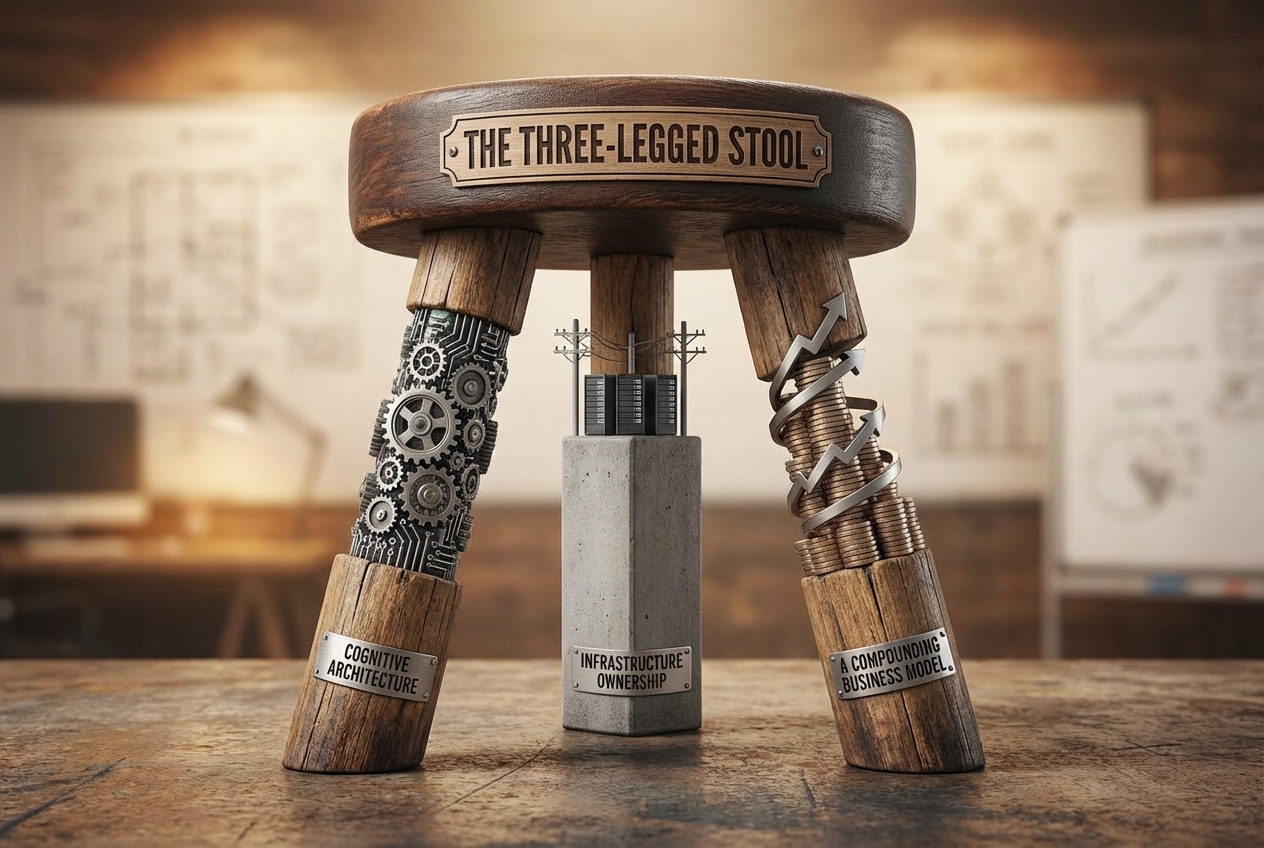
The Three-Legged Stool - Cognitive architecture - Infrastructure ownership - A compounding business model
A durable AI strategy isn't built on one breakthrough.
It's built on three foundational decisions that most companies get wrong.
- Cognitive architecture Stop obsessing over model size and start obsessing over governance. The intelligence isn't in the LLM. It's in the system that coordinates, constrains, and directs it. Get this wrong and you're just adding horsepower to a car with no steering wheel.
- A compounding business model Your support queue isn't a cost center. It's a training ground. Every human interaction should be feeding a flywheel that makes your AI smarter, your moat deeper, and your unit economics better over time. If your AI isn't learning from your operations, you're leaving money on the table every single day.
- Infrastructure ownership The cloud is convenient. It's also a trap. When you rent your compute, you rent your future. Owning your infrastructure isn't just a 7x cost advantage. It's a strategic position. It's the answer to every enterprise procurement team asking where their data actually lives.
Get those three right and you're building on bedrock.
Get them wrong and you're just another company hoping the next funding round comes through before the foundation cracks.
So here's the question worth sitting with.
As AI becomes table stakes for every industry, will your company be built on rented hype or on something that actually lasts?
If you're ready to stop chasing scale and start building smart, we should talk. Our expert consultation sessions are on sale right now for just $49, a savings of $200.
Book one at gorombo.com/expert-sessions and let's figure out what your architecture should actually look like.
Frequently Asked Questions
10 questions about this topic
1 What is governance-first AI?
Governance-first AI is an architectural approach that prioritizes coordination, control, and reliability over raw model size. Instead of chasing bigger models with more parameters, governance-first systems focus on the layers that direct and constrain AI behavior. The result is predictable, trustworthy output rather than volatile capability.
2 Why are bigger AI models not always better?
Bigger models have more raw capability but not more reliability. Without proper governance, larger models hallucinate at scale, contradict themselves, and produce confident wrong answers. Intelligence comes from coordination, not size. A well-governed smaller system will outperform an ungoverned larger one in production environments every time.
3 What is the SIM-ONE Framework?
The SIM-ONE Framework is a governance-first AI architecture built on the Five Laws of Cognitive Governance. It treats intelligence as an emergent property of coordination rather than scale. The framework enables deterministic reliability through architectural design, making AI systems predictable and trustworthy for enterprise deployment.
4 What is the difference between colocation and cloud for AI infrastructure?
Cloud means renting compute from providers like AWS or Azure on a recurring basis. Colocation means owning your hardware but housing it in a professional data center that handles power, cooling, security, and network redundancy. Colocation gives you ownership and control without the operational burden of running your own facility.
5 How much cheaper is colocation than cloud for AI workloads?
For GPU-intensive AI workloads, colocation can be up to 7x cheaper than cloud. An 8x H100 GPU setup in colocation runs approximately $50,000 per year compared to around $350,000 for equivalent cloud infrastructure. Over time, this difference compounds into millions in savings.
6 Why is colocation better than self-hosting AI infrastructure?
Self-hosting requires you to manage power infrastructure, cooling systems, physical security, redundant networking, backup generators, and compliance certifications. That's a massive operational burden. Colocation gives you all the benefits of ownership without the nightmare of running a data center yourself.
7 What is the HRLF Flywheel?
HRLF stands for Human-Reinforced Learning Feedback. The HRLF Flywheel is a system where every human support interaction becomes training data for your AI. Each correction teaches specialized AI agents how to coordinate better. Over time, this creates a compounding advantage that competitors cannot replicate.
8 How can customer support become a competitive advantage with AI?
When your AI architecture is designed to learn from human corrections, every support interaction does double duty. It solves the customer's problem and trains your system. This turns support from a cost center into a strategic asset that builds a moat competitors cannot copy.
9 What is governed cognition in artificial intelligence?
Governed cognition is the principle that reliable AI behavior comes from the systems that coordinate and constrain the model, not from the model itself. Think of it like this. The model is the engine. Governance is the driver. Without governance, you have raw power with no direction.
10 What makes an AI strategy durable long-term?
A durable AI strategy rests on three pillars. First, a cognitive architecture that prioritizes governance over scale. Second, a business model that turns operational costs into compounding assets. Third, an infrastructure strategy that favors ownership over rent. Get all three right and you're building on bedrock.
Still have questions?
Get personalized answers from our expert team.